
What is Oak Wilt
Understanding how Oak Wilt affects oak trees, how the disease spreads, and why early identification matters.
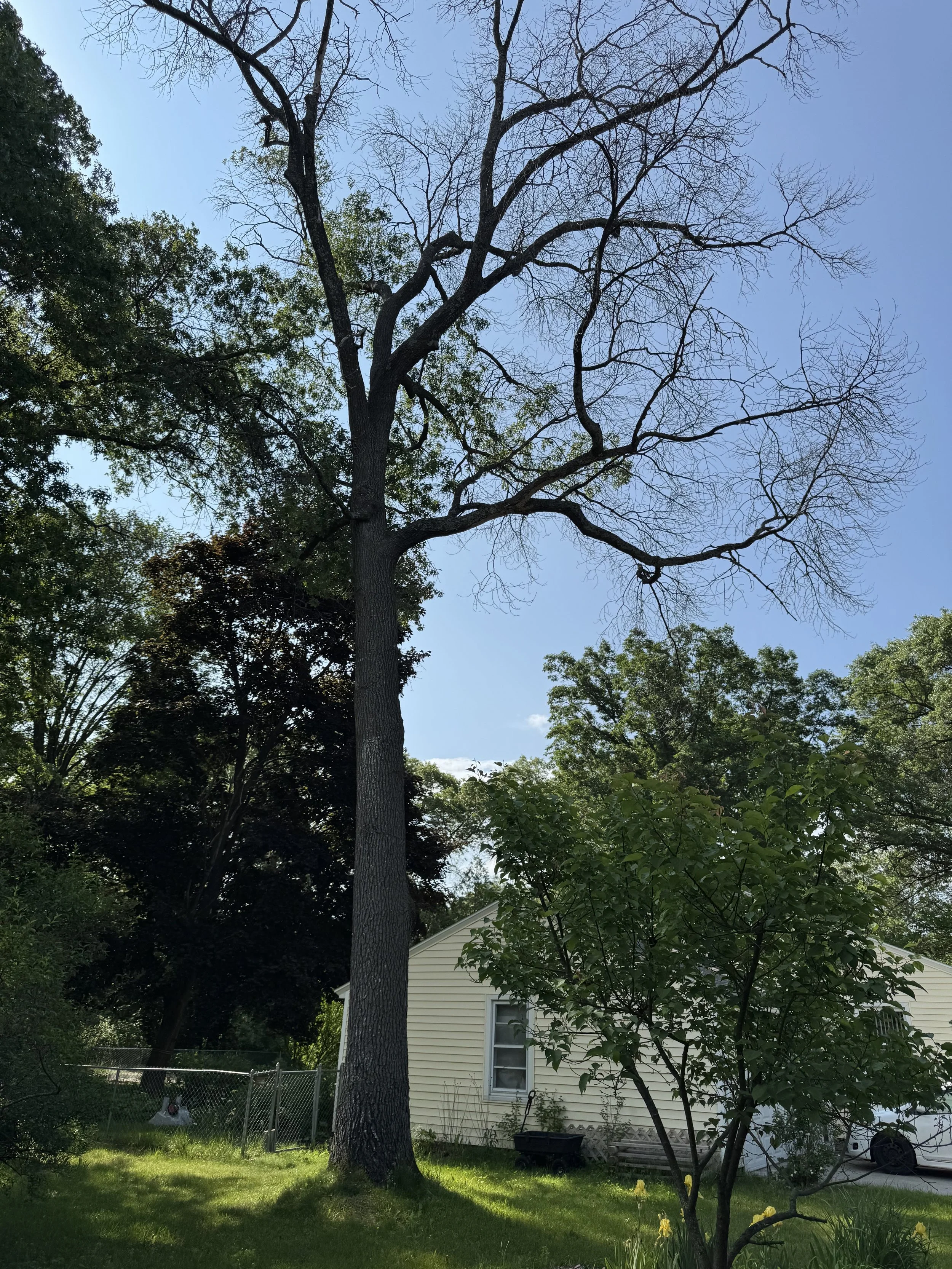
Why This Matters
Oak trees are an important part of Northern Michigan’s forests, residential landscapes, recreational properties, and communities. Mature oaks provide shade, wildlife habitat, ecological value, and a sense of permanence that may take generations to replace.
Oak Wilt is a serious disease capable of killing otherwise healthy oak trees and spreading through groups of nearby oaks. Trees in the red oak group are particularly vulnerable and may decline rapidly after symptoms become visible.
Because Oak Wilt can spread both below ground through connected root systems and over land through insect activity, a single infected tree may affect more than one property or stand of oaks. Early identification, accurate diagnosis, and a coordinated management plan can improve the opportunity to protect surrounding trees and limit additional spread
Understanding how Oak Wilt behaves is the first step toward prevention and effective management.
What Causes Oak Wilt?
Oak Wilt is a vascular disease caused by the fungal pathogen Bretziella fagacearum, formerly known as Ceratocystis fagacearum.
The fungus affects the water-conducting tissues within an infected tree. As the disease progresses, the tree’s ability to transport water through its vascular system becomes increasingly disrupted. Leaves may wilt, discolor, and fall prematurely as portions of the canopy can no longer receive adequate water.
Although Oak Wilt affects oak species differently, the disease is especially aggressive in trees belonging to the red oak group.
Red Oaks and White Oaks Respond Differently
Not all oak species respond to Oak Wilt in the same way.
Red Oak Group
Northern red oak, black oak, northern pin oak, and scarlet oak are members of the red oak group and are highly susceptible to Oak Wilt.
Red oaks commonly have leaves with pointed lobes ending in small bristle tips. Once infected, trees in this group may develop symptoms rapidly and can die within several weeks to one growing season.
Red oaks also play an important role in the overland spread of the disease because certain recently killed trees may develop fungal spore mats beneath the bark.
White Oak Group
White oak species are generally more resistant to Oak Wilt and may respond differently after infection.
White oaks commonly have leaves with rounded lobes. The disease may progress more slowly within these trees, sometimes affecting individual branches or portions of the canopy over several years. Some white oaks may survive infection for an extended period.
However, greater resistance does not mean immunity. Symptoms in white oaks should still be evaluated carefully, particularly when Oak Wilt is known or suspected nearby.
How Oak Wilt Spreads
Oak Wilt spreads through two primary pathways:
1. Underground Spread Through Root Grafts
In many established oak stands, the roots of neighboring trees may naturally grow together and form connections known as root grafts.
These connections can allow water, nutrients, and other materials to move between trees. Unfortunately, they can also provide a pathway for the Oak Wilt fungus to move from an infected oak into nearby healthy oaks.
Root-graft transmission is responsible for much of the local spread observed within oak stands. Over time, the disease may move outward from the original infection and create an expanding area of declining and dead trees known as an Oak Wilt infection center.
The visible symptoms in one tree may therefore represent only part of a larger underground disease process.
2. Overland Spread by Sap-Feeding Beetles
Oak Wilt can also spread to previously unaffected areas through insect activity.
Certain sap-feeding beetles may visit fungal spore mats that develop beneath the bark of some recently killed red oaks. The beetles can pick up fungal spores and transport them to fresh wounds on healthy oak trees.
Fresh pruning cuts, storm-damaged branches, construction injuries, and other wounds may provide an entry point for the fungus.
This form of transmission can establish a new Oak Wilt infection in an area that was not previously connected to an existing infection center.
UFT INSIGHT
The most effective way to manage Oak Wilt is to prevent new infections whenever possible. UFT recommends avoiding pruning or intentionally wounding oak trees from May through November and completing planned oak pruning during the dormant season.
What Are the Common Symptoms of Oak Wilt?
Oak Wilt symptoms can vary depending on the oak species, the timing of infection, environmental conditions, and the stage of disease development.
Possible symptoms may include:
Rapid wilting or discoloration of leaves
Browning or bronzing beginning near the outer portions or margins of the leaf
Premature leaf drop during the growing season
Green, partially discolored, or brown leaves falling from the canopy
Thinning of the upper canopy
Progressive branch dieback
Rapid canopy decline
Sudden mortality, particularly in red oaks
Multiple nearby oaks developing similar symptoms over time
In red oaks, symptoms may begin near the upper portion of the canopy and progress downward. Significant leaf drop may occur while portions of the foliage are still green or only partially discolored.
White oaks may show slower or less uniform decline. Symptoms may initially be limited to individual branches or portions of the canopy.
A Symptom Is Not the Same as a Diagnosis
Wilting leaves, premature leaf drop, canopy thinning, and branch dieback are not unique to Oak Wilt.
Similar symptoms may be associated with:
Drought or prolonged heat
Root damage
Soil compaction
Construction disturbance
Changes in drainage
Other vascular diseases
Insect activity
Root dysfunction
Environmental stress
Long-term tree decline
The presence of one symptom does not confirm Oak Wilt. Diagnosis should consider the tree species, symptom pattern, timing, surrounding oak population, site history, nearby tree mortality, and the progression of symptoms.
When necessary, laboratory testing may be used to help confirm the presence of the Oak Wilt pathogen.
Accurate identification is important because Oak Wilt management may involve decisions affecting multiple trees—not only the tree showing visible symptoms.
Why Early Identification Matters
Oak Wilt management becomes more complex as an infection center expands.=
Early identification may provide more time to:
Evaluate the pattern and extent of the suspected infection
Identify nearby oaks that may be at risk
Determine whether diagnostic testing is appropriate
Develop a coordinated management plan
Consider root-graft disruption where appropriate
Properly manage infected trees and wood
Evaluate preventive treatment options for selected high-value oaks
Monitor surrounding trees for additional symptoms
Prompt evaluation is particularly important when symptoms appear in a red oak during the growing season or when several nearby oaks begin declining in a similar pattern.
Can an Infected Oak Be Saved?
Once a red oak is infected and develops Oak Wilt, there is currently no treatment that eliminates the disease and restores the infected tree. Management generally focuses on limiting additional spread and protecting nearby oaks.
White oaks may respond differently because they are generally more resistant and may compartmentalize the infection more effectively. Some may survive for years after infection. Management decisions should be based on the individual tree, symptom severity, site conditions, and diagnostic findings.
Preventive fungicide treatments may be appropriate for certain high-value, apparently healthy oaks at risk of exposure. These treatments are intended to help protect selected trees and are not a substitute for managing an active infection center.
What Should Property Owners Do if Oak Wilt Is Suspected?
If an oak develops rapid wilting, premature leaf drop, significant canopy decline, or sudden mortality, avoid making immediate management decisions based only on the visible symptoms.
Instead:
Document when symptoms first appeared
Photograph changes in the canopy and leaves
Note whether nearby oaks are showing similar symptoms
Avoid pruning or creating additional wounds
Do not immediately remove the tree without considering possible root-graft transmission
Avoid moving potentially infected wood until it has been evaluated
Consult a qualified arborist or Oak Wilt Specialist
Oak Wilt management should consider the entire site—including surrounding oaks, root connections, the history of tree loss, and the potential for continued disease spread.
A Long-Term Approach to Oak Preservation
Oak Wilt is a serious disease, but informed prevention and timely management can reduce its impact.
Protecting oak resources requires more than responding to individual dead trees. Effective management may involve preventing new infections, recognizing disease patterns early, evaluating underground root connections, coordinating tree removal with root-graft disruption, properly handling infected wood, protecting selected high-value trees, and continuing to monitor the site over time.
Each Oak Wilt site is different. Tree species, stand density, soil conditions, property boundaries, infection history, and surrounding land use may all influence management decisions.
The goal is not simply to remove affected trees. It is to understand how the disease may be moving through the site and develop a management strategy that protects as many healthy oaks as reasonably possible.
Sources & Further Reading
This article reflects established arboricultural principles, current Oak Wilt guidance, professional field experience, and UFT’s preservation-focused approach to tree care. For additional information, explore educational resources from:
Michigan Department of Natural Resources — Oak Wilt Information
Michigan State University Extension — Oak Wilt Education and Prevention
Michigan Oak Wilt Coalition — Oak Wilt Resources
USDA Forest Service — Oak Wilt Research and Management
HEALTHY SOIL. | STRONGER TREES. | LASTING LANDSCAPES.
Concerned about possible Oak Wilt activity on your property? UFT Tree Care Specialists provides science-based Oak Wilt evaluation, consulting, management planning, and plant health care throughout Northern Michigan.
ufttree.care • ben@ufttree.care • 231-409-0442
