
Signs Your Tree May Be In Trouble
Common warning signs of tree stress—and why understanding the underlying cause matters.
Why This Matters
Trees often show signs of stress long before the underlying problem is fully understood. Changes in leaf color, canopy density, branch growth, or seasonal appearance may indicate that a tree is responding to unfavorable growing conditions, root disturbance, insects, disease, environmental stress, or a combination of factors.
Some changes are part of a tree’s normal seasonal cycle. Others may be temporary responses to drought, heat, severe weather, or transplanting. However, symptoms that are unusual for the species, continue to worsen, or appear across multiple parts of the tree may justify a closer evaluation.
Recognizing these changes early can provide more time to identify the underlying cause, consider appropriate management options, and support the tree before decline becomes more advanced.
A Symptom Is Not the Same as a Diagnosis
One of the most important principles in tree care is that a visible symptom does not necessarily reveal its cause.
Yellow leaves, for example, may be associated with root stress, poor drainage, soil conditions, nutrient availability, drought, insects, disease, or other environmental factors. Branch dieback may result from problems affecting the roots, trunk, branches, vascular system, or surrounding growing environment.
Different problems can produce similar symptoms, and more than one stressor may be affecting a tree at the same time. Treating the most visible symptom without understanding the underlying cause may fail to address the actual problem.
A useful diagnosis considers the entire tree—including the canopy, trunk, root flare, root zone, site history, surrounding soil, recent weather, and changes to the landscape.
UFT INSIGHT
The first question should not always be, “What should we treat?” It should often be, “What is causing the tree to respond this way?”
Thinning or Uneven Foliage
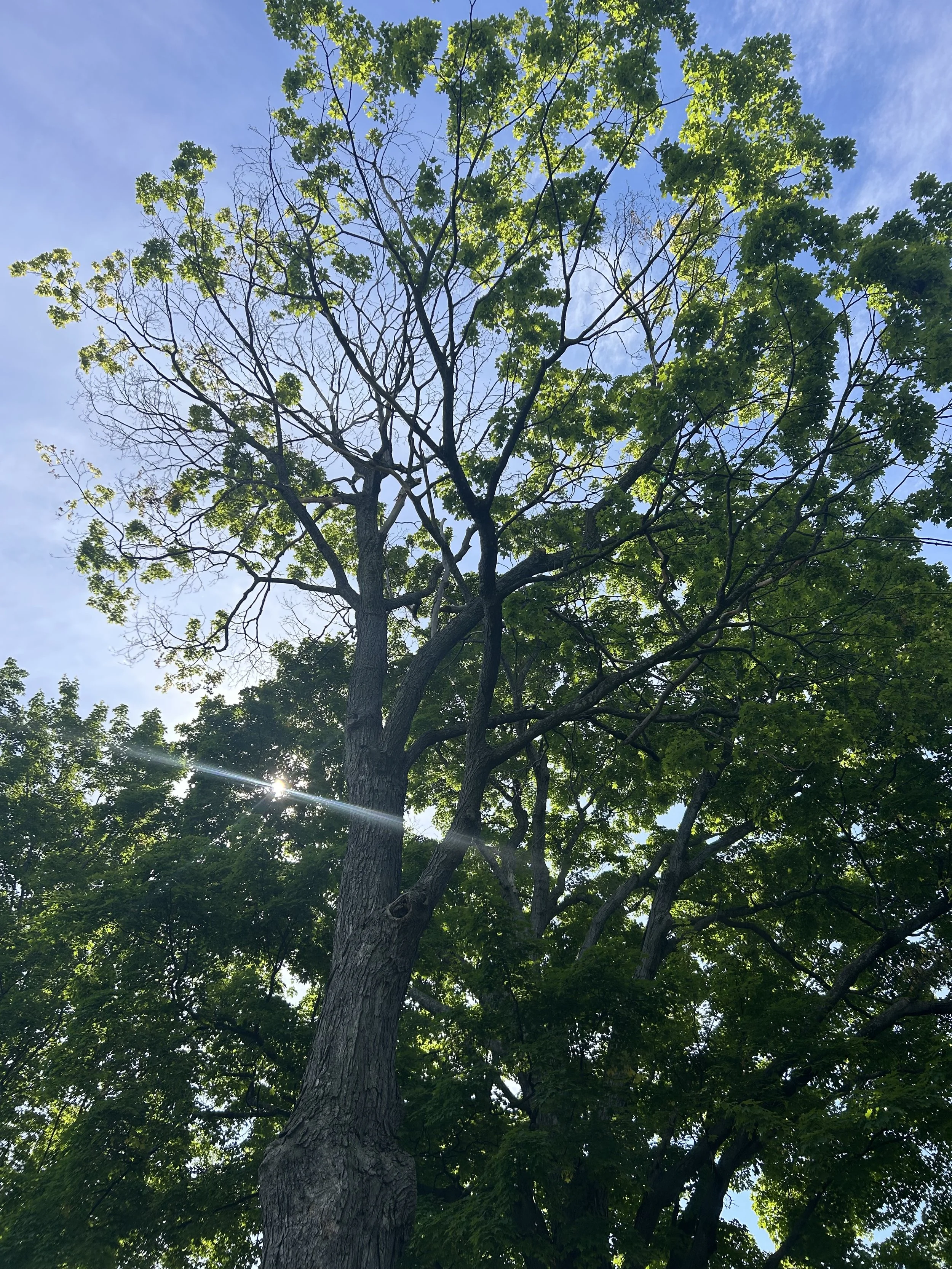
A healthy canopy should generally appear appropriate for the tree’s species, age, and growing conditions. If the canopy becomes noticeably thinner, more open, or uneven compared with previous years, the tree may be experiencing stress.
Possible observations include:
More visible sky through the canopy
Fewer leaves than expected
Sparse foliage near the top of the tree
Uneven leaf density between major branches
Sections of the canopy that appear weaker than others
A gradual reduction in canopy fullness over several growing seasons
Canopy thinning may develop slowly and can be difficult to recognize when a tree is viewed every day. Comparing current photographs with images from previous years may help reveal gradual changes.
A thin canopy is not a diagnosis by itself. Root disturbance, drought, soil compaction, construction injury, insects, disease, poor growing conditions, and other factors may all contribute to reduced foliage. Smaller or fewer leaves, crown dieback, and premature fall color are recognized indicators of tree decline, but the underlying cause still requires evaluation.
Dead Branches or Progressive Dieback
An occasional small dead branch can be a normal part of a tree’s development. Trees naturally shed some shaded, damaged, or less productive branches over time.
More extensive or progressive dieback may be a greater concern, particularly when:
Multiple branches are dying throughout the canopy
Dieback begins near branch tips and progresses inward
Large limbs are affected
One side of the canopy is declining
Dead branches appear in the upper canopy
The amount of deadwood increases from year to year
Branch dieback may be associated with root loss, vascular problems, drought, construction damage, insects, disease, decay, or long-term environmental stress. Because dead branches may also create a safety concern, their size, location, and condition should be considered in addition to the health of the tree.
Smaller-Than-Normal Leaves or Reduced Growth
A tree under chronic stress may produce smaller leaves, shorter shoots, or less annual growth than it did previously.
Changes may include:
Leaves that are noticeably smaller than those on similar trees
Short distances between buds along newer twigs
Reduced extension growth at branch tips
Fewer new shoots
A gradual loss of canopy density
Slower recovery following pruning, drought, or other stress
Growth naturally varies by species, age, weather, and site conditions. A mature tree may not grow as rapidly as a young tree, and one slow-growing season does not necessarily indicate a serious problem.
However, a continuing reduction in growth—especially when combined with canopy thinning, leaf discoloration, or branch dieback—may indicate that the tree is struggling to maintain normal function. Small leaves, thinning foliage, and canopy dieback can occur with several types of tree stress and decline.
Unusual Leaf Color
Leaves provide useful information about how a tree is responding to its environment. Color changes outside the tree’s normal seasonal pattern may indicate stress.
Watch for:
Yellow or pale foliage during the growing season
Scorched or browning leaf margins
Unusual red or purple coloration
Patchy discoloration within the canopy
Leaves that appear dull or less vibrant than normal
One branch or section of the canopy changing color before the rest
Leaf discoloration may be associated with drought, heat, root damage, soil conditions, nutrient availability, insects, disease, or other environmental factors. Similar symptoms can have very different causes, so leaf color alone should not be used to determine a treatment.
When comparing foliage, it can be helpful to look at nearby trees of the same species growing under similar conditions. Different species naturally vary in leaf color, size, density, and seasonal timing.
Premature Fall Color or Early Leaf Drop
A tree that begins changing color or losing leaves significantly earlier than similar trees nearby may be responding to stress.
Possible observations include:
Fall color appearing unusually early
Leaves dropping during summer
One portion of the canopy changing color before the rest
Repeated early leaf loss over several years
A noticeably shorter growing season than nearby trees of the same species
Drought, excessive moisture, root injury, soil compaction, heat, insects, disease, and other stresses may contribute to premature color or leaf drop.
Some trees may shed leaves temporarily during periods of severe heat or drought and recover later. The timing, severity, pattern, and recurrence of the symptom all provide useful diagnostic information.
Wilting, Curling, or Scorched Leaves
Leaves that wilt, curl, or develop brown margins may indicate difficulty maintaining adequate moisture within the canopy.
Potential contributing factors include:
Drought or prolonged heat
Root damage
Soil compaction
Poor water infiltration
Excessive soil moisture
Restricted rooting space
Vascular dysfunction
Salt exposure
Certain insects or diseases
The condition of the soil matters as much as the amount of water applied. Compacted soil may limit water infiltration and oxygen movement, while saturated soil may reduce the oxygen available to roots.
Before increasing irrigation, it is important to understand the actual soil conditions. Both overly dry and overly wet soils can negatively affect root function.
Changes in the Bark or Trunk
The trunk provides structural support and contains tissues responsible for transporting water, nutrients, and energy throughout the tree.
Changes worth observing may include:
Cracks or splits
Loose, peeling, or missing bark
Sunken or discolored areas
Open wounds
Areas that remain wet or appear to seep
Unusual swelling
Cavities or decayed wood
New damage from equipment, vehicles, construction, or wildlife
Not every bark feature indicates a serious problem. Bark appearance varies greatly among tree species, and some trees naturally develop ridges, plates, peeling bark, or deep furrows as they mature.
Changes that are new, expanding, associated with dead branches, or affecting a large portion of the trunk may justify professional evaluation.
Fungal Growth or Decay
Mushrooms, conks, or other fungal fruiting structures growing on or near a tree may indicate the presence of fungal activity. Their significance depends on the fungal species, location, affected tissues, and condition of the tree.
Pay particular attention to fungal growth:
At the base of the trunk
Around the root flare
Directly from exposed roots
On large branches
Near old wounds or cavities
In combination with canopy decline or visible decay
The visible fungal structure is only one part of the organism and should not automatically be interpreted as proof that a tree must be removed. However, some fungi are associated with wood decay or root dysfunction and may warrant further assessment, particularly when structural concerns are present. Fungal conks near the base of a tree can occur with certain root and butt decay conditions.
Read More at:
Mushrooms Are Growing Near My Tree—Should I Be Concerned?
Problems at the Base of the Tree
The transition between the trunk and roots—often called the root flare or trunk flare—is an important area to observe.
Potential concerns include:
A trunk that enters the ground like a straight pole
Soil or mulch piled against the trunk
Excessive mulch depth
Girdling or circling roots
Bark that remains buried or constantly moist
Wounds from mowers or string trimmers
Decay or fungal growth near the root flare
Changes in soil grade around the tree
A healthy root flare is often visibly wider where the trunk transitions into the major structural roots. When this area is buried, important conditions may be hidden from view.
Problems at the root flare can affect tree health gradually and may not become visible in the canopy for years.
Changes in the Root Zone
The condition of the area surrounding a tree can be just as important as visible symptoms in the canopy.
Consider whether any of the following have occurred:
Construction or excavation
Trenching for utilities
Changes in soil grade
New driveways, patios, sidewalks, or retaining walls
Repeated vehicle or equipment traffic
Soil compaction
Changes in drainage
Prolonged flooding or standing water
Removal of nearby trees
Heavy foot traffic
Root cutting
Significant changes in irrigation
Tree roots can extend well beyond the edge of the canopy. Disturbance does not have to occur directly beside the trunk to affect the tree.
The effects of root injury may also be delayed. A tree may continue to appear relatively normal for months or years while gradually losing vigor.
What Property Owners Can Look For
No single symptom proves that a serious tree problem is present. However, several changes occurring together—or a pattern that worsens over time—may justify a closer evaluation.
Watch for:
A canopy that is becoming thinner
Increasing numbers of dead branches
Smaller-than-normal leaves
Reduced annual growth
Unusual leaf color
Premature fall color
Early leaf drop
Wilting or leaf scorch
New bark damage, cracks, cavities, or decay
Fungal growth on the trunk, roots, or root flare
A buried or damaged root flare
Recent construction or root-zone disturbance
A noticeable difference between the tree and nearby trees of the same species
Photographs can be valuable for tracking gradual changes. Taking pictures from approximately the same location each year may help reveal changes in canopy density, branch dieback, or overall appearance.
When Professional Evaluation Is Useful
A professional evaluation may be appropriate when
Symptoms continue to worsen
Multiple parts of the tree are affected
Large branches are dying
The tree has experienced construction or root disturbance
Decay, cavities, cracks, or fungal growth are present
The tree is located near a home, driveway, road, play area, or other frequently occupied space
The tree has significant environmental, landscape, historical, or personal value
A treatment is being considered without a clear diagnosis
An arborist can evaluate the tree together with its growing environment and consider the pattern, timing, severity, site conditions, and likely contributing factors.
Additional investigation may include soil evaluation, root-flare inspection, root-collar excavation, laboratory testing, monitoring, or a more detailed tree-risk assessment when appropriate.
A Long-Term Approach to Tree Health
Trees are long-lived organisms, and decline is not always caused by one event. In many cases, several stresses accumulate over time.
A tree may experience root disturbance, drought, soil compaction, limited rooting space, storm damage, insects, disease, or other challenges at different points in its life. The effects may interact, reducing the tree’s ability to respond to future stress.
Early observation does not guarantee that every problem can be corrected. It can, however, provide more time to understand what is happening and determine whether monitoring, soil improvement, pruning, treatment, risk assessment, or another management strategy is appropriate.
The goal is not simply to react to visible symptoms. It is to understand the tree, its site, and the factors influencing its long-term health.
Sources & Further Reading
This article reflects established arboricultural principles and professional field experience. For additional information, explore educational resources from:
International Society of Arboriculture — Tree Owner Resources
University of Minnesota Extension — Tree and Shrub Diagnostic Resources
Michigan State University Extension — Trees and Forests
Read More at:
Mushrooms Are Growing Near My Tree—Should I Be Concerned?
HEALTHY SOIL. | STRONGER TREES. | LASTING LANDSCAPES.
Concerned about changes in one of your trees? UFT Tree Care Specialists provides science-based tree diagnostics, consulting, and plant health care throughout Northern Michigan.
ufttree.care • ben@ufttree.care • 231-409-044
